
Where are you from, and how long have you been in the Metro D.C. area?
I grew up in Long Island, New York, and went to college outside Philadelphia. I spent three years in the D.C. area from 2004 to 2007 while I was attending law school, and then I moved out west for a few years. I came back to D.C. for a job in 2011 and have been in the D.C. metro area ever since.
Can you tell us a little about yourself?
I’ve been totally blind since birth, and I’ve always liked being physically active. As a kid I was on the track team in school and fell in love with skiing when we went to visit my aunt and uncle in Colorado. I love having outdoor adventures, both for the connection I feel with nature and for how alive I feel when I’m trying something new and unfamiliar. As a college student I spent one of my spring breaks backpacking on the Appalachian Trail in West Virginia with some friends and have enjoyed hiking and camping ever since. I’ve also always enjoyed writing and public speaking, which led me to pursue a career as a lawyer. I’ve worked for several different public interest organizations bringing civil rights cases and representing workers, and I even got to argue a case on behalf of fast food workers at the U.S. Supreme Court in 2022. I currently work as the Deputy Director of the Disability Rights Program at the American Civil Liberties Union or ACLU.
You founded MWABA in 2015. What made you decide to start MWABA? Can you tell us about the history of the organization?
When I was living in California after law school, I got connected with an adaptive sports program called BORP that had weekly goalball practices and a tandem biking program, as well as other adaptive sports programs for wheelchair users like wheelchair basketball and power soccer. When I moved back to D.C. in 2011, I missed the community and regular exercise that I’d experienced through participating in adaptive sports with BORP. I occasionally took the train up to Philadelphia to attend their goalball practices, but that just wasn’t the same as having a sports community in the place where I lived. Also, from talking to other blind people in the D.C. area during those years, I knew that there was a demand for such a program here and that many people would participate if one was offered.
I had been looking for a partner to help me start a program for a while when I got connected to Justin Chan, who had recently moved to the D.C. area and who was also interested in starting a goalball program here. We started meeting regularly in 2014 with the main objective of bringing goalball to Washington, D.C. We found a venue, Trinity University, to host a “learn goalball clinic” in June of 2015, and the Columbia Lighthouse loaned us some goalball equipment that they had on hand. Claire Posteraro, who’s still on the MWABA board to this day, was also part of those early planning meetings for the event at Trinity.
Around the same time that we were planning the goalball clinic, we decided to think bigger and create MWABA as a local sports club affiliated with the U.S. Association of Blind Athletes. My training as a lawyer and Justin’s training as an accountant made us confident enough to file our own incorporation documents to register as a nonprofit without paying someone to do it for us, and when I received a letter back from the IRS with our official TAX ID number, it started to feel real that we had actually created something new.
The goalball clinic was a huge success, and we continued to hold goalball practices at Trinity, and later at the Edlavitch DC Jewish Community Center, before finding our current home at the Columbia Heights Community Center. What proved most important about that clinic was that two of the people who came to it to check out goalball were Lori Pierce and Kurt Sloop, who became stalwart members of D.C.’s growing goalball community and of all that MWABA would eventually evolve into.
Remembering the many different programs offered by BORP, I also wanted to expand MWABA to include activities beyond goalball, and we were able to do that when we found some yoga instructors willing to volunteer their time and started offering yoga classes at various branches of the D.C. Public Library. During that time period several MWABA members also tried out judo, often instructed and always encouraged by early MWABA board member Mark Smith, who we sadly lost to cancer in 2018. We held a Try Judo event in Mark’s honor in 2019 and hope to hold another one soon.
The most ambitious expansion we undertook, though, was to add tandem cycling in 2017, which necessitated a partnership with the Washington Metropolitan Area Transit Authority (WMATA) for the lockers to store our tandem bikes, as well as acquiring enough tandem bikes (both by buying our own and accepting donations of used tandems from others) to run regular rides. Bonnie O’Day and Bob Hart, a blind couple who created a successful tandem bike program in Alexandria, Virginia, called Tuesday Night Tandems, provided invaluable assistance and guidance as we were planning this stage of our development. We held our first new captain training at Eastern Market in the spring of 2017 with lots of help from the Tuesday Night Tandems folks and other blind cyclists in the area like Denna Lambert and Angie Moran, and current MWABA board member Shira Gordon showed up as a trainee. The rest, as they say, is history.
It is incredible to think about how far MWABA has come in the last 10-plus years. What were your expectations when you first started the organization and how do you feel about where the organization stands today?
My hope when I started MWABA was to create a fun and supportive space for blind and visually impaired adults and youth to be physically active. I also had a sense, from my time participating in BORP, that by bringing people together around that common objective, friendships would form and a community would naturally develop, and I wanted to help facilitate that. I never dreamed that MWABA would have grown as much as it has in the decade since, and that it would now be offering two tandem rides a week and multiple hikes and camping trips every year, let alone hosting a goalball tournament with 16 teams from all over the country. I’m so grateful to everyone who’s been part of that growth, from the people like Claire, Kurt and Lori who were there from the beginning at Trinity to the many people who have joined since.
What are you most proud of about MWABA?
I’m incredibly proud of the way in which blind athletes who participate in MWABA activities have stepped up to lead the organization and to expand its reach into new areas. In particular, I was thrilled that former board member Qudsiya Naqui spearheaded the hiking program a few years ago, and more recently that Kevin Andrews and others began organizing the bike-camping and car-camping trips that MWABA has offered since 2023. My impetus for starting MWABA was to share the joys I’ve found in sports and outdoor activities with others, and that’s what I see other MWABA members doing in becoming ambassadors for activities that they love and scaling them up so that more people in the DMV blind community can experience them. The number of people stepping up and taking on leadership roles has been so great that I’ve been able to step back from leadership and haven’t been on the board for several years now, which I think is a sign of a healthy and growing organization.
Are you still involved in any MWABA sports or activities?
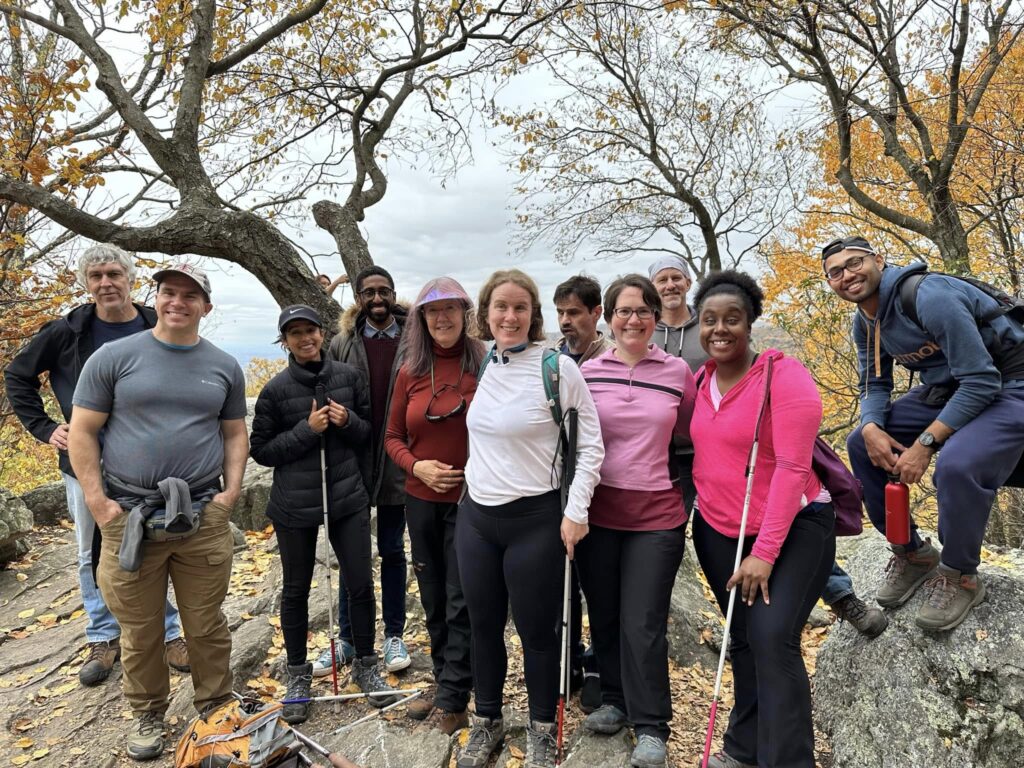
I still participate in MWABA’s tandem bike rides, hikes and camping trips, as I love the combination of exercise, being outdoors, and getting to spend quality time with others that those activities provide. I also still come to goalball practices every so often for old time’s sake, though my joints definitely complain to me about it afterwards.
How has being involved in adaptive sports impacted you over the years?
My involvement in adaptive sports has given me a better understanding of my own body, of how it feels to move through space, and of how to notice and react to changes in my physical environment, because those are all skills and abilities that participating in sports like goalball and judo, and outdoor activities like hiking and tandem biking, can help to develop. Pushing myself to my physical limits has also given me greater confidence in what I’m capable of, and made me realize that with training and persistence, I can do much more than I would have initially thought possible. That faith in myself and dedication to a work ethic to achieve results have definitely carried over to other facets of my life outside of sports. Finally, working closely with others in athletics, whether it’s my tandem captain or my goalball teammates, has made me a better communicator and strengthened my ability to tune in and pay attention to how others around me are doing, so I think that sports have also been good for training my emotional intelligence.
What is something that people might not know about you?
I’m an adrenaline junkie and love anything that gives me the sensation of going really fast. I’ve been given birthday gifts of riding alongside racecar drivers and flying in a plane doing acrobatic maneuvers like flipping upside down. Probably the most amazing rush I’ve ever had though was skydiving from 13,000 feet; the free fall was like what I imagine it would feel like to fly.
Any advice for younger blind athletes or for someone thinking about coming out to a MWABA event for the first time?
Some people are intimidated by the word “athlete” and think that MWABA events aren’t for them if they don’t work out all the time or haven’t done a lot of sports before. But these events are for everyone in the blind and visually impaired community, and are all about trying out new things and meeting new people. So my advice is to come out, do as much as you’re comfortable doing, and not to be shy about asking questions if you’ve never done something before and aren’t sure how it all works. Chances are that others at the event were once newbies too and will be happy to share their tips and tricks about playing goalball, riding a tandem bike, hiking with a cane, or whatever else you’re interested in learning how to do as a blind person. Plus, MWABA people are fun people, so you should come for the socializing, and you may find that you enjoy the athletics part more than you thought you would.